Previous: Regeneration of Rh and Pd TWC Catalysts After Automotive Fuel Shutoff
Regenerate the Expensive Catalyst Rh and Pd On Three-Way-Catalysts (TWC)
BASF Sponsorship, Columbia University, 02/2014 - 08/2015
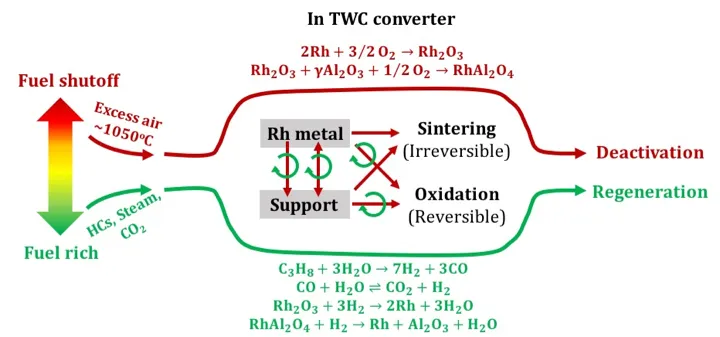
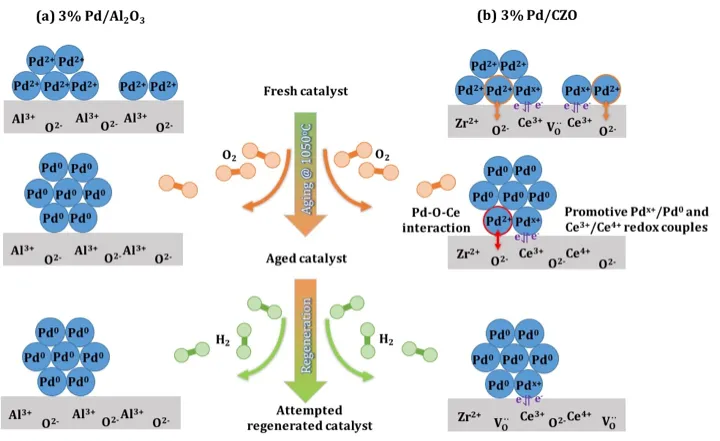
Modern three way catalysts (TWC) for automotive emission control, are composed of bimetallic Rh-Pd catalysts deposited on stabilized Al2O3. TWC experiences catalyst deactivation during fuel shutoff, an engine operational mode (e.g. coasting down hill) for enhancing fuel economy. A subsequent switch to fuel rich mode allows catalyst regeneration and the maintenance of catalyst performance. Different deactivation and regeneration effects were observed with supported Rh and Pd model TWCs. The research focuses on the influences of the two simulated processes on the Rh- and Pd-based TWC catalyst systems. The studies highlight the examination of catalyst redox chemistry, surface physicochemistry, and regenerability with metal-support interactions.
- Zheng, Q.; Farrauto, R.*; Deeba, M.; Valsamakis, I. Part I: A comparative thermal aging study on the regenerability of Rh/Al2O3 and Rh/CexOy-ZrO2 as model catalyst for automotive three way catalysts. Catalysts. 2015, 5(4), 1770-1796.
- Zheng, Q.; Farrauto, R.*; Deeba M. Part II: Oxidative thermal aging on Pd/Al2O3 and Pd/CexOy-ZrO2 in automotive three way catalysts: The effects of fuel shutoff and attempted fuel rich regeneration. Catalysts. 2015, 5(4), 1797-1814.